

Featured













Frequently Asked Questions
At Electric Bikes Brisbane — Brisbane's dedicated ebike specialists since 2013 — we stock lightweight electric bikes across every riding style: commuter, urban, folding, gravel, road, and electric mountain bike. This collection covers them all. Whether you're riding to work along the Bicentennial Bikeway, touring the Brisbane River Loop on a Saturday morning, or hitting SEQ trail networks, there's a lightweight ebike built for what you have in mind.
"Lightweight" isn't a single number. It's a design philosophy — and the right weight for your ride depends entirely on what you're doing with the bike. Here's how we think about it.
What Makes a Lightweight Ebike?
Weight in an electric bike comes down to every major system: frame material, motor, battery, and components. Getting any one of them wrong undermines the rest.
- Frame materials account for roughly a quarter of an ebike's total weight. Aluminium delivers strength and value. Carbon fibre saves 1–1.5kg versus aluminium and allows engineers to tune stiffness in ways aluminium can't match — but it costs more and is harder to repair. One-piece moulding, internal cable routing, and integrated batteries all reduce weight while improving balance and aesthetics.
- Motor systems have come a long way. The Bosch Performance Line SX and Shimano EP600, for example, are compact, efficient, and tuned specifically for a natural ride feel.
- Batteries are the single heaviest component. Newer 21700 and 4680 cell formats pack more watt-hours per kilogram than older designs. Modular approaches — a smaller internal battery paired with a removable range extender — are increasingly popular for keeping base weight low without sacrificing flexibility on longer days.
- Components matter more than most riders expect. Rotating mass — wheels, tyres, drivetrain — affects how lively a bike feels moment to moment. Carbon bars, one-piece cockpits, belt drives, and lightweight wheelsets all contribute. So does what you're not carrying: the Orbea Carpe 25 at 17.7kg has no rack or mudguards by design, while the Carpe 10 at 20.9kg includes a full integrated rack, belt drive, and electronic Di2 gearing.
- Weight distribution matters as much as the number on the scale. A well-balanced 25kg commuter with low, central mass can feel more agile and confidence-inspiring than a poorly balanced lighter bike. A 25kg commuter with a rear rack, mudguards, kickstand, and integrated lighting represents real, functional equipment — not dead weight.
-Every gram saved has a trade-off. Smaller batteries reduce range. Lighter tyres may puncture more easily. Lightweight components are at the premium end o fthe ranges and cost more. The goal is always balance — matching the build to the rider and the ride.
Who Is a Lightweight Ebike For?
- Commuters, apartment dwellers, and travellers are the obvious first group. If you're carrying your bike upstairs, loading it onto a car rack, or storing it in a motorhome or caravan, every kilogram is felt. The ADO folding range — including the Air Carbon at just 15kg with battery — was built specifically for this kind of life. And if riding rail trails is part of your plan the Kalkhoff Entice L Season has been designed with this mind.
- Experienced cyclists who want a natural ride feel are the second group. If you understand gearing and cadence, if you ride with analogue cyclists, if you want motor assist rather than motor dependence — a lightweight ebike is built for you. A lighter bike responds faster, corners more intuitively, and rolls past the 25km/h assist limit without the drag that heavier full-power motors can create. Nick, our co-owner and a mountain biker for 30 years who has ridden trails across the world, rode the Orbea Rise for several years specifically for this reason: "it rides like a proper mountain bike with just enough assist." What he valued most was how well it performed past the 25km/h cutoff — it didn't hold him back on connectors and flat sections the way full-power bikes can. (For the full Rise story, see our lightweight electric mountain bikes collection.)
- Riders with size or strength considerations make up the third group. Lighter and smaller riders, or anyone for whom handling and manoeuvring a heavy bike is genuinely difficult, will find a lightweight build makes the whole experience more enjoyable and sustainable.
The Motor Systems Behind Lightweight Ebikes
Not all lightweight motors are the same. Here's what's powering our current range and what each system is designed to do.
Bosch Performance Line SX — Kalkhoff L Range
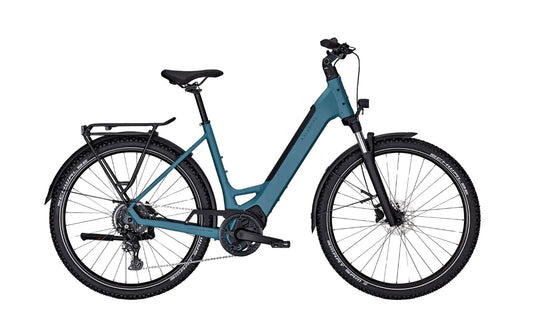
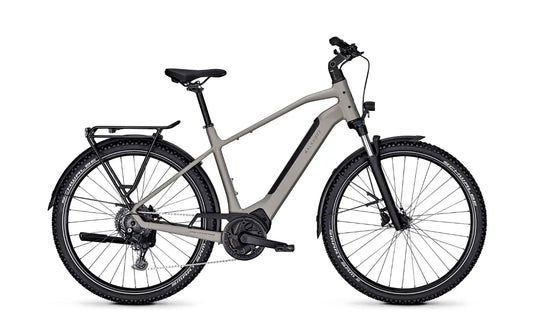
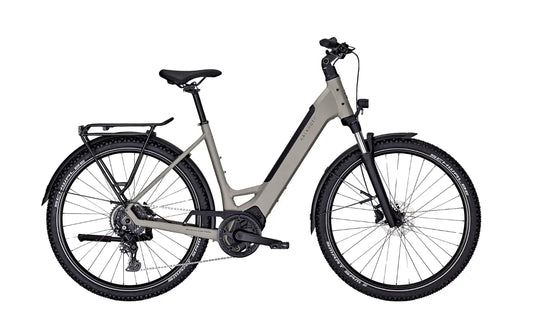
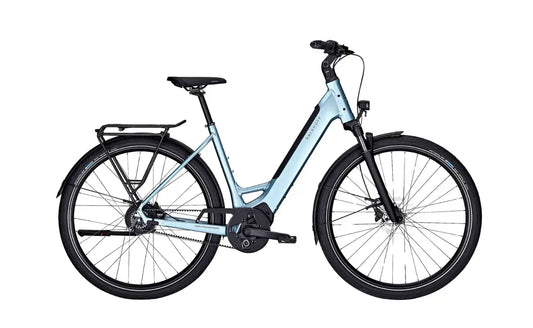
The Bosch Performance Line SX produces 60Nm of torque and weighs approximately 1.9kg — significantly lighter than the full-power Bosch CX. It's the motor in our Kalkhoff Entice L Season and Kalkhoff Image L range, and it's one our co-owner Sam, rides herself on Saturday morning group rides with the EBB Owners Club.
Sam rode a Kalkhoff L with the Bosch SX up Heartbreak Hill on the Brisbane River Loop and kept pace with riders on higher-powered motors. Her honest assessment: the SX suits cyclists who understand gearing and cadence. It rewards you for working with the motor rather than relying on it.
The Kalkhoff L range sits in the 20–23kg bracket fully equipped including rear rack, mudguards, kickstand, and lights.
See the full Kalkhoff range.
Shimano EP600 — Orbea Carpe Urban Range
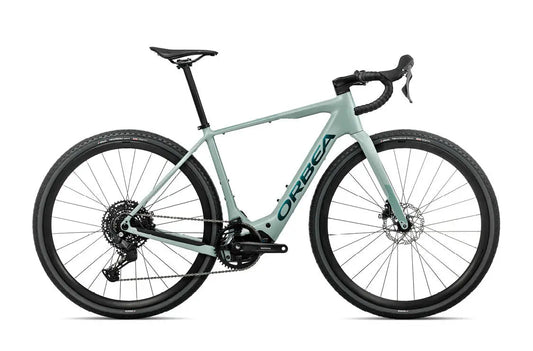
The Orbea Carpe is new to our range and has quickly become one of our most talked-about urban ebikes. All three models — Carpe 10, Carpe 20, and Carpe 25 — run the Shimano EP600 mid-drive motor delivering up to 85Nm of torque. Orbea has applied a custom RS tune that gives the motor a refined, urban-focused character.
The 420Wh battery is fully integrated into the down tube, with an optional 252Wh range extender available. The carbon fork, Twin Glide Flex frame (which absorbs road vibration via flex in the seat tube), 90°-rotating handlebar, and folding pedals make these bikes genuinely practical for city storage and transport.
- • Carpe 25: 17.7kg — no rack, mudguards, or kickstand. Lean, sporty, minimal.
- • Carpe 20: 19.7kg — mudguards, rack, lighting included. Daily commuter ready.
- • Carpe 10: 20.9kg — electronic Shimano Nexus Di2 internal gearing, Gates CDX belt drive, foldable stem. The full package.
Orbea specifically designed the Carpe for hilly cities, and Brisbane was front of mind. Read our full Orbea Carpe overview on the EBB blog.
Bafang Hub Motor — ADO Folding Range
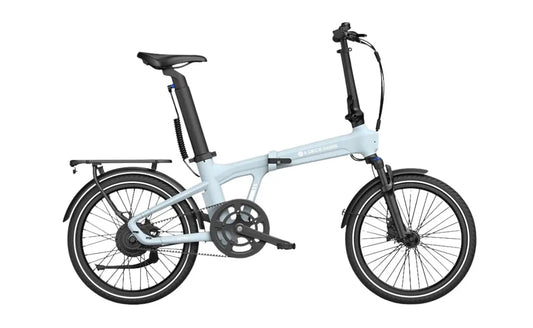
The ADO Air range uses a Bafang auto-transmission rear hub motor with up to 50Nm of torque — motor and gearing combined in the rear hub, which simplifies the drivetrain and reduces maintenance points.
ADO has achieved some of the lightest builds available in Australia through a combination of carbon frame construction (Air Carbon), a battery-integrated seatpost design, carbon belt drive, and IP66/67-rated motor protection. The Air Carbon tips the scales at 12.5kg without battery — 15kg with — making it one of the lightest electric bikes you can buy in Australia today. The ADO range folds compactly, fits easily into a car boot or motorhome, and handles most of Brisbane's everyday terrain without drama.
Shimano EP801 RS — Lightweight eMTBs
The Shimano EP801 RS — 85Nm, tuned for trail riding and natural feel — features in our lightweight eMTB range, including the Orbea Rise with builds starting from 16.3kg. For the full picture, including Nick's multi-year ownership experience and how these bikes perform on SEQ trails, visit our lightweight electric mountain bikes collection.
Explore by Category
Lightweight ebikes cover a broad spectrum. If you know which style you're after, these collections go deeper:
- • Lightweight electric mountain bikes — sub-20kg trail eMTBs built for natural feel on SEQ singletrack. The Orbea Rise range lives here.
- • Lightweight rail trail electric bikes — lighter weight ebikes designed to enjoy gravel and tarmac, carry gear and enjoy the little adventures that come riding our extensive Australian rail trail network.
- • ADO electric bikes — the full ADO range including the Air Carbon, Australia's lightest folding ebike.
- • Road and gravel electric bikes — by nature light and fast, with or without power.
- • Electric mountain bikes Brisbane — if you're weighing up lightweight versus full-power eMTB, start here for the full comparison across both categories.
Frequently Asked Questions
Lightweight ebike or full-power ebike — which one actually suits how I ride?
If most of your riding is commuting, fitness loops, or rail trails without major elevation, a lightweight ebike gives you a more natural, bike-like feel and is far easier to lift onto a car rack, up stairs, or into a motorhome garage. If you're regularly climbing steep terrain like D'Aguilar or carrying cargo, a full-power model with a higher-torque motor will feel noticeably stronger. Our team can talk through your typical routes before you commit either way.
Is a lightweight ebike still a good option for older riders or anyone getting back into cycling?
Yes — this is one of the most common reasons customers choose a lightweight model over a standard ebike. A lighter bike is easier to control at low speed, easier to manoeuvre in a garage or apartment lift, and easier to walk up a driveway or ramp without help. It won't out-climb a full-power motor on the steepest hills, but for general fitness and confidence-building riding it's often the more comfortable everyday choice.
Can I test ride a lightweight e-bike at EBB before deciding?
Yes — every model in this range is available to test ride from our Milton store, and we'd encourage it, since weight and motor feel are hard to judge from a spec sheet alone. We can set up a route to suit what you'd actually be riding, whether that's a flat loop or a hillier stretch nearby.